Note
Go to the end to download the full example code.
Parallel Computation with joblib
This example shows how to speed up shapiq explanations using parallel
computation via joblib. We use a simple
synthetic game to keep runtime short.
from __future__ import annotations

import numpy as np

import shapiq
Define a Synthetic Game
A lightweight callable that we can explain quickly.
rng = np.random.default_rng(42)
n_features = 8
weights = rng.standard_normal(n_features)


def synthetic_model(x: np.ndarray) -> np.ndarray:
    """Simple linear model with interaction term."""
    return x @ weights + 0.5 * x[:, 0] * x[:, 1]


# Create synthetic data
X_background = rng.standard_normal((100, n_features))
X_test = rng.standard_normal((6, n_features))
Explain a Single Instance
explainer = shapiq.Explainer(
    model=synthetic_model,
    data=X_background,
    index="k-SII",
    max_order=2,
    random_state=0,
)
print(f"Explainer type: {type(explainer).__name__}")

iv = explainer.explain(X_test[0], budget=256)
print(iv)

shapiq.network_plot(interaction_values=iv, feature_names=[f"x{i}" for i in range(n_features)])
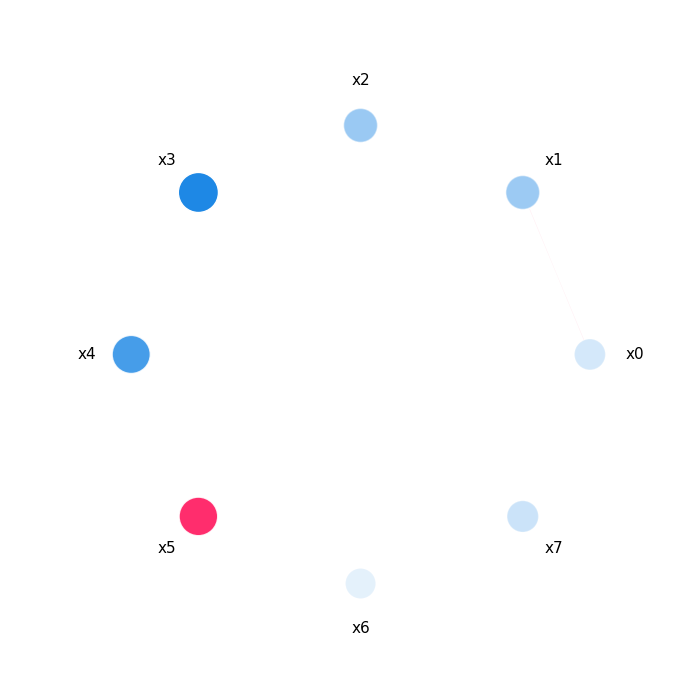
Explainer type: TabularExplainer
InteractionValues(
    index=k-SII, max_order=2, min_order=0, estimated=False, estimation_budget=256,
    n_players=8, baseline_value=0.3123873157557045,
    Top 10 interactions:
        (5,): 0.5176617604224146
        (): 0.3123873157557045
        (0, 1): 0.03694416821294271
        (6,): -0.06933886474896339
        (0,): -0.11273767052197357
        (7,): -0.13650218150318102
        (1,): -0.26220142180607664
        (2,): -0.26702088906477955
        (4,): -0.4915673889725629
        (3,): -0.5965700317709164
)

(<Figure size 700x700 with 1 Axes>, <Axes: >)
Parallel Explanation of Multiple Instances
Use n_jobs in explain_X() to parallelize.
ivs = explainer.explain_X(X_test, budget=256, n_jobs=2)
print(f"Computed {len(ivs)} explanations")
Computed 6 explanations
Global Feature Importance
shapiq.plot.bar_plot(ivs, feature_names=[f"x{i}" for i in range(n_features)])
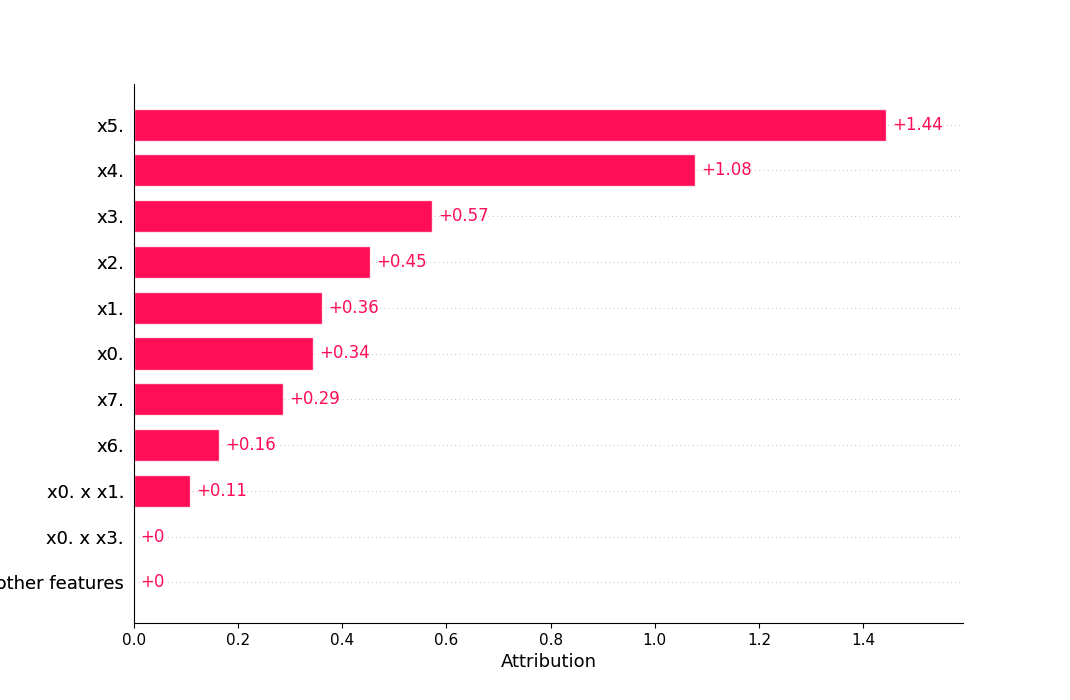
<Axes: xlabel='Attribution'>
Total running time of the script: (0 minutes 8.620 seconds)