Note
Go to the end to download the full example code.
Conditional Data Imputation
This example shows how to use ConditionalImputer for
conditional (observational) imputation when computing Shapley interactions.
Conditional imputation respects feature dependencies, unlike marginal
(interventional) imputation.
from __future__ import annotations

from sklearn.ensemble import RandomForestRegressor
from sklearn.model_selection import train_test_split

import shapiq
Load Data and Train Model
X, y = shapiq.load_california_housing()
X_train, X_test, y_train, y_test = train_test_split(
    X.values,
    y.values,
    test_size=0.25,
    random_state=42,
)
n_features = X_train.shape[1]

model = RandomForestRegressor(
    n_estimators=100,
    max_depth=n_features,
    max_features=2 / 3,
    max_samples=2 / 3,
    random_state=42,
)
model.fit(X_train, y_train)
print(f"Train R2: {model.score(X_train, y_train):.4f}")
print(f"Test  R2: {model.score(X_test, y_test):.4f}")
Train R2: 0.7965
Test  R2: 0.7431
Conditional Imputer
Set imputer="conditional" in TabularExplainer.
The imputer trains a gradient boosting model per feature to learn the
conditional distribution. Key parameters:
sample_size: samples drawn from conditional backgroundconditional_budget: coalitions per data point for trainingconditional_threshold: quantile threshold for neighbourhood
Explain a Single Instance
InteractionValues(
    index=SII, max_order=2, min_order=0, estimated=False, estimation_budget=256,
    n_players=8, baseline_value=2.0701874006108745,
    Top 10 interactions:
        (5,): 0.07038429654931853
        (0, 1): 0.0685624534150431
        (0, 2): 0.03439873622519084
        (5, 7): 0.033631328292567465
        (2,): 0.02005664341751958
        (1, 5): -0.019260969594264977
        (0, 7): -0.02620411996774764
        (7,): -0.13540992365657364
        (0,): -0.14778623990718284
        (1,): -0.15014305418246202
)
Network Plot
shapiq.network_plot(interaction_values=iv, feature_names=list(X.columns))
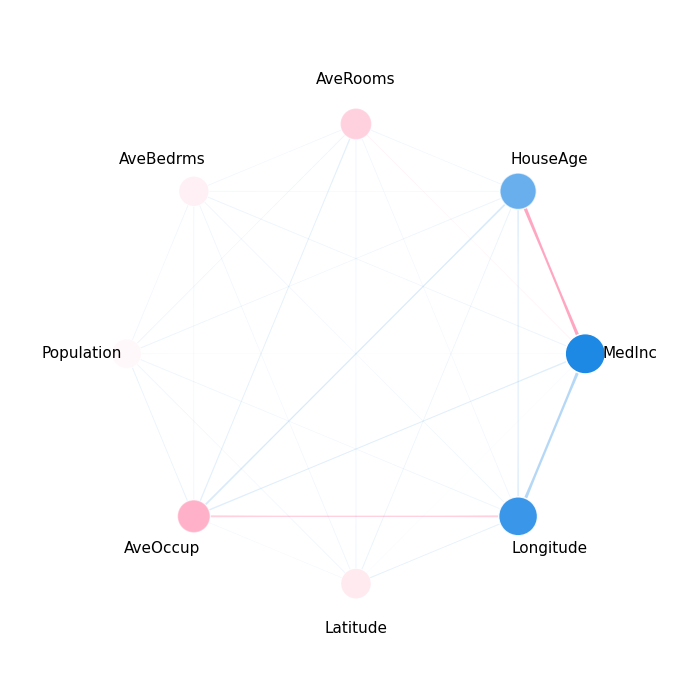
(<Figure size 700x700 with 1 Axes>, <Axes: >)
Total running time of the script: (1 minutes 4.160 seconds)