Note
Go to the end to download the full example code.
Explaining Sentiment Analysis
This example shows how to explain a sentiment classifier using shapiq.
Each token in the input text becomes a player in a cooperative game, and
Shapley values quantify each token’s contribution to the predicted sentiment.
We use the SentimentAnalysisLocalXAI game
from the shapiq_games package, which wraps a pretrained DistilBERT model
fine-tuned on IMDb reviews.
from __future__ import annotations

import os

# Prevent OpenMP/MKL thread conflicts with PyTorch backend
os.environ.setdefault("OMP_NUM_THREADS", "1")
os.environ.setdefault("MKL_NUM_THREADS", "1")

import shapiq
from shapiq_games.benchmark import SentimentAnalysisLocalXAI
/home/docs/checkouts/readthedocs.org/user_builds/shapiq/checkouts/latest/examples/language/plot_sentiment_analysis.py:23: DeprecationWarning: This collection of games is deprecated and will be removed in a future version.
  from shapiq_games.benchmark import SentimentAnalysisLocalXAI
Set Up the Sentiment Game
Each word in the input becomes a player. The game value for a coalition
is the model’s sentiment score when only those tokens are visible (absent
tokens are replaced with [MASK]). The score is normalized so that the
empty coalition maps to 0.
game = SentimentAnalysisLocalXAI(
    input_text="I really loved this amazing film",
    mask_strategy="mask",
    normalize=True,
)
token_names = game.input_text.split()
print(f"Tokens (players): {token_names}")
print(f"Number of players: {game.n_players}")
print(f"Grand coalition (full-text sentiment): {game.grand_coalition_value:.3f}")
Warning: You are sending unauthenticated requests to the HF Hub. Please set a HF_TOKEN to enable higher rate limits and faster downloads.

Loading weights:   0%|          | 0/104 [00:00<?, ?it/s]
Loading weights: 100%|██████████| 104/104 [00:00<00:00, 11774.44it/s]
Tokens (players): ['i', 'really', 'loved', 'this', 'amazing', 'film']
Number of players: 6
Grand coalition (full-text sentiment): 0.472
Compute Shapley Values
approx = shapiq.KernelSHAP(n=game.n_players, random_state=42)
sv = approx.approximate(budget=50, game=game)
print(sv)
InteractionValues(
    index=SV, max_order=1, min_order=0, estimated=True, estimation_budget=50,
    n_players=6, baseline_value=0.0,
    Top 10 interactions:
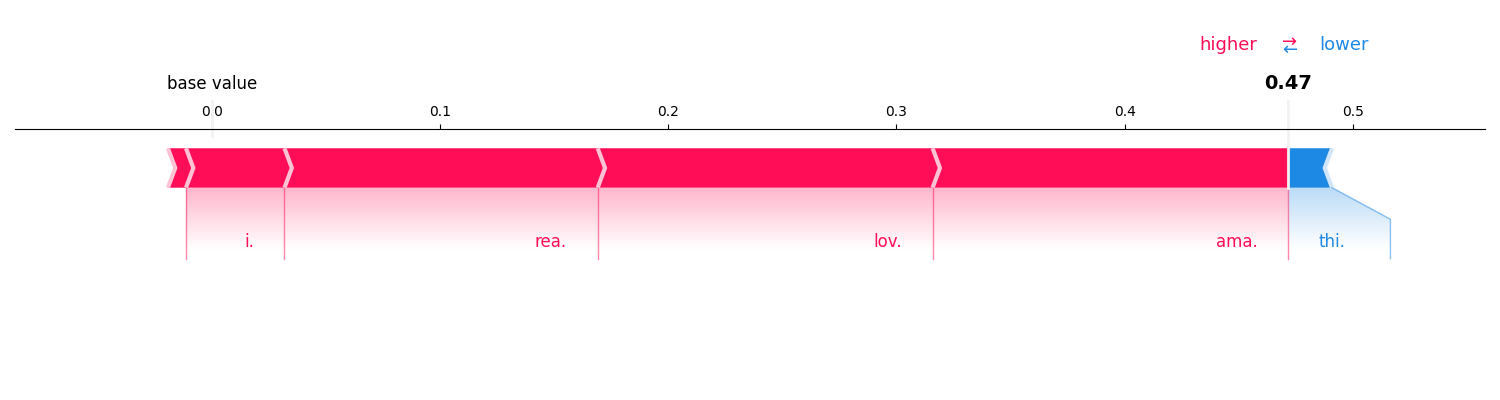
        (4,): 0.1558469806793941
        (2,): 0.14672764952252848
        (1,): 0.13720909157496924
        (0,): 0.04315812899110444
        (5,): 0.007910941040173603
        (): 0.0
        (3,): -0.019169167720165813
)
Force Plot
Shows how each token pushes the sentiment away from the baseline (all tokens masked).
sv.plot_force(feature_names=token_names)
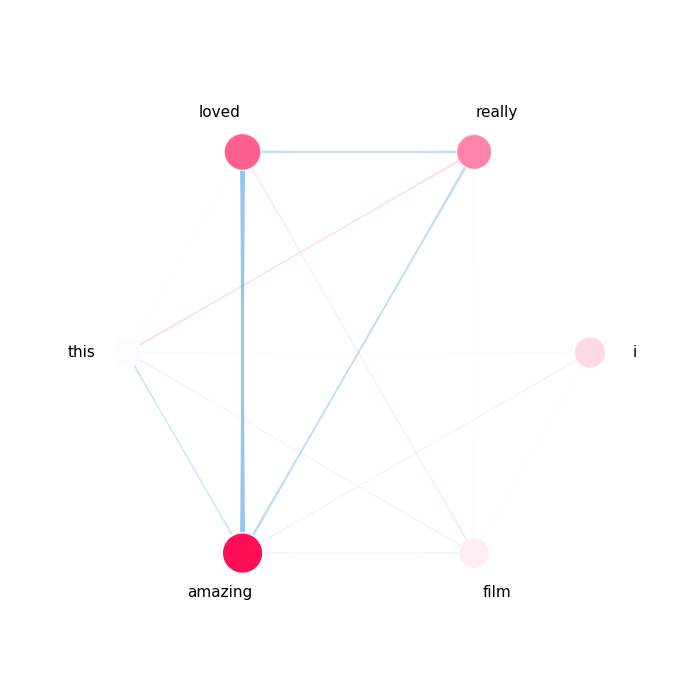
Second-Order Interactions
Pairwise interactions reveal which tokens amplify or dampen each other’s effect on the sentiment.
approx_sii = shapiq.KernelSHAPIQ(
    n=game.n_players,
    index="k-SII",
    max_order=2,
    random_state=42,
)
sii = approx_sii.approximate(budget=50, game=game)

sii.plot_network(feature_names=token_names)
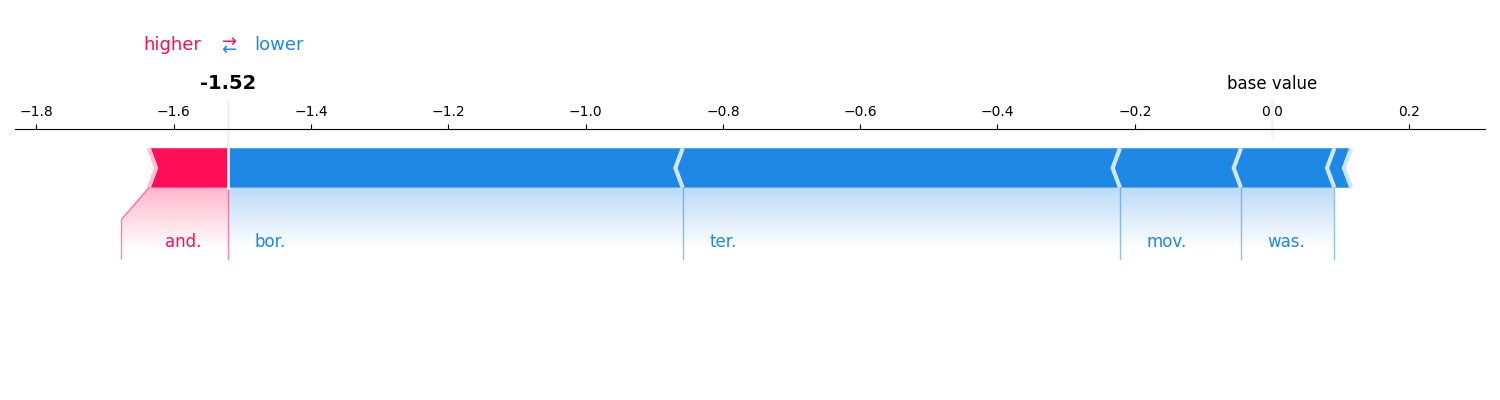
Negative Sentiment Example
Let’s also explain a negative review.
game_neg = SentimentAnalysisLocalXAI(
    input_text="This movie was terrible and boring",
    mask_strategy="mask",
    normalize=True,
)
token_names_neg = game_neg.input_text.split()
print(f"Tokens: {token_names_neg}")
print(f"Sentiment: {game_neg.grand_coalition_value:.3f}")

sv_neg = shapiq.KernelSHAP(n=game_neg.n_players, random_state=42).approximate(
    budget=50,
    game=game_neg,
)
sv_neg.plot_force(feature_names=token_names_neg)
Loading weights:   0%|          | 0/104 [00:00<?, ?it/s]
Loading weights: 100%|██████████| 104/104 [00:00<00:00, 11829.04it/s]
Tokens: ['this', 'movie', 'was', 'terrible', 'and', 'boring']
Sentiment: -1.521
Sentence Plot
The sentence_plot() colors each word by its first-order
attribution, giving an inline text visualization.
sv.plot_sentence(words=token_names)

sv_neg.plot_sentence(words=token_names_neg)

References
Total running time of the script: (0 minutes 20.982 seconds)