Note
Go to the end to download the full example code.
KernelSHAPIQ
Regression-based k-SII approximation using
KernelSHAPIQ Fumagalli et al.[1].
from __future__ import annotations

import numpy as np

import shapiq

N_PLAYERS = 8
BUDGET = 200
feature_names = [f"x{i}" for i in range(N_PLAYERS)]

weights = np.array([0.4, 0.3, 0.2, 0.1, 0.05, -0.1, -0.2, -0.3])


def game_fun(coalitions: np.ndarray) -> np.ndarray:
    coalitions = np.atleast_2d(coalitions)
    return (coalitions @ weights) + 0.5 * coalitions[:, 0] * coalitions[:, 1]
Approximate k-SII values
approximator = shapiq.KernelSHAPIQ(n=N_PLAYERS, max_order=2, random_state=42)
iv = approximator.approximate(BUDGET, game_fun)
print(iv)
InteractionValues(
    index=k-SII, max_order=2, min_order=0, estimated=True, estimation_budget=200,
    n_players=8, baseline_value=0.0,
    Top 10 interactions:
        (0, 1): 0.4955548266654287
        (0,): 0.39559949611125533
        (1,): 0.3072185227427836
        (2,): 0.1823271504601657
        (3,): 0.09776947056277069
        (4,): 0.03651114793157625
        (3, 7): -0.004693642153617183
        (5,): -0.09454435430256364
        (6,): -0.18585628885194566
        (7,): -0.28902513671630814
)
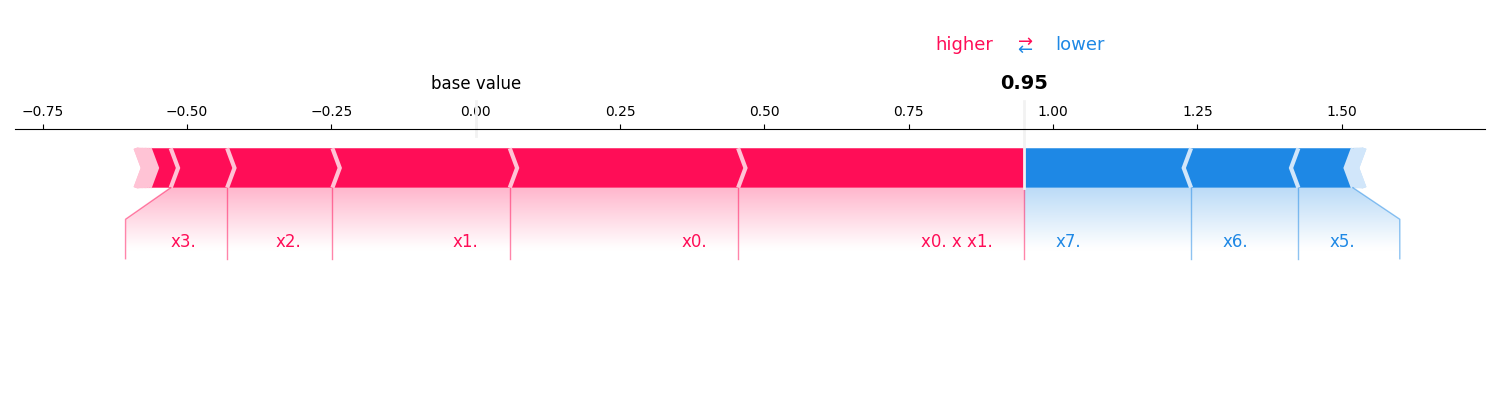
Force plot
iv.plot_force(feature_names=feature_names)
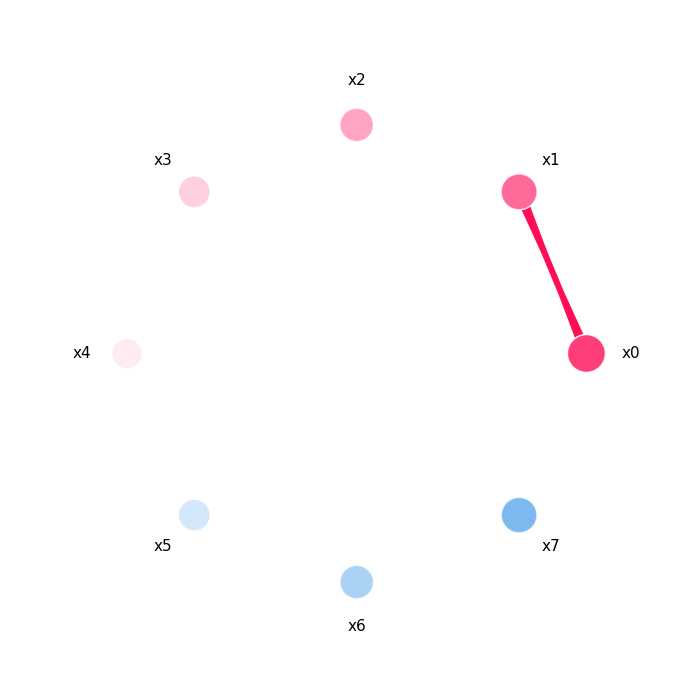
Network plot
iv.plot_network(feature_names=feature_names)
References
Total running time of the script: (0 minutes 0.677 seconds)