Note
Go to the end to download the full example code.
kADDSHAP
k-additive SHAP approximation using
kADDSHAP Pelegrina et al.[1].
from __future__ import annotations

import numpy as np

import shapiq

N_PLAYERS = 8
BUDGET = 200
feature_names = [f"x{i}" for i in range(N_PLAYERS)]

weights = np.array([0.4, 0.3, 0.2, 0.1, 0.05, -0.1, -0.2, -0.3])


def game_fun(coalitions: np.ndarray) -> np.ndarray:
    coalitions = np.atleast_2d(coalitions)
    return (coalitions @ weights) + 0.5 * coalitions[:, 0] * coalitions[:, 1]
Approximate k-SII values
approximator = shapiq.kADDSHAP(n=N_PLAYERS, max_order=2, random_state=42)
iv = approximator.approximate(BUDGET, game_fun)
print(iv)
InteractionValues(
    index=kADD-SHAP, max_order=2, min_order=0, estimated=True, estimation_budget=200,
    n_players=8, baseline_value=0.0,
    Top 10 interactions:
        (0,): 0.6499998957047455
        (1,): 0.5499999337513763
        (0, 1): 0.5000000189002506
        (2,): 0.1999999773702765
        (3,): 0.09999997629115459
        (4,): 0.050000025597011166
        (2, 3): 4.6072518455419126e-08
        (5,): -0.09999994000414143
        (6,): -0.19999995959985686
        (7,): -0.29999990911056545
)
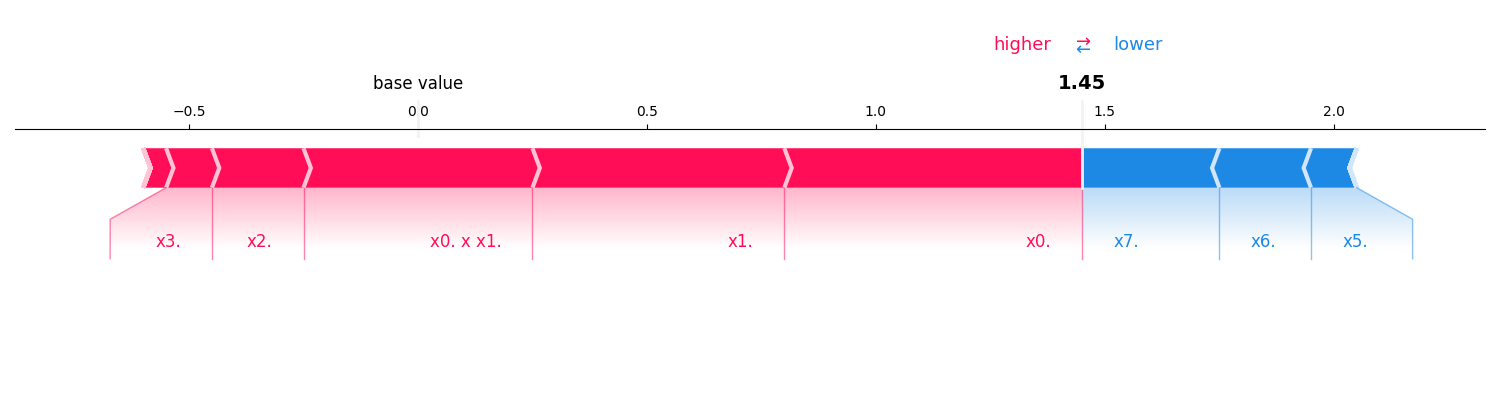
Force plot
iv.plot_force(feature_names=feature_names)
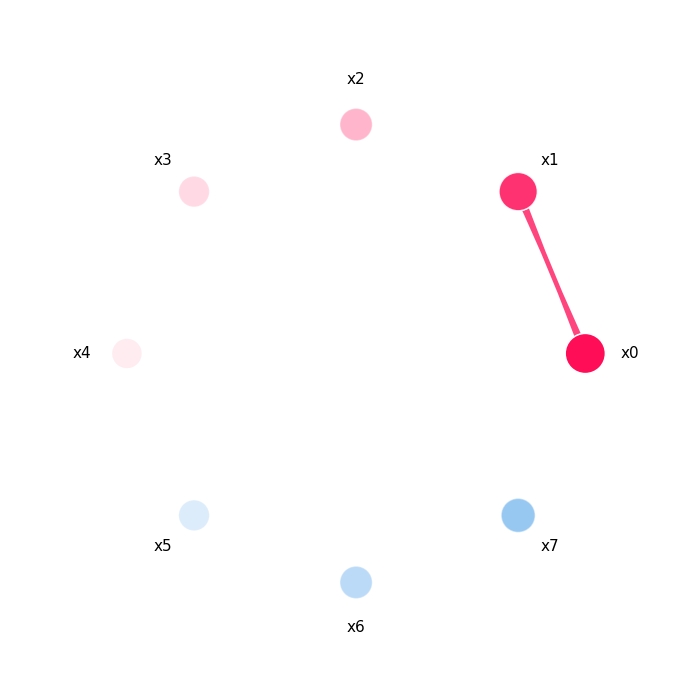
Network plot
iv.plot_network(feature_names=feature_names)
References
Total running time of the script: (0 minutes 0.655 seconds)